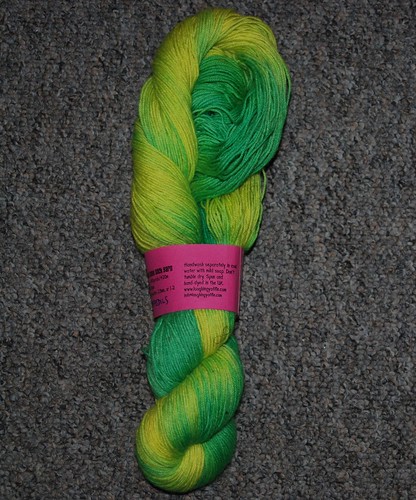
I always like the look of variegated yarns before I start to knit with them – the colours contrast so nicely! However, they never seem to look as good knitted up, so I tend not to buy them. I made an exception for this lovely green and yellow sock yarn – I don’t normally go for yellow at all, but this particular yellow paired with this particular green did appeal. It has taken me some months to find a way of knitting with it where I liked the result.
This is really a four-part blog post, but as I can only post one picture at a time, it will have to be four separate posts. The posts should be read in reverse chronological order, i.e. variegated yarn, first attempt, second attempt, success.

Thursday, 26 July 2012
Variegated yarn

First attempt
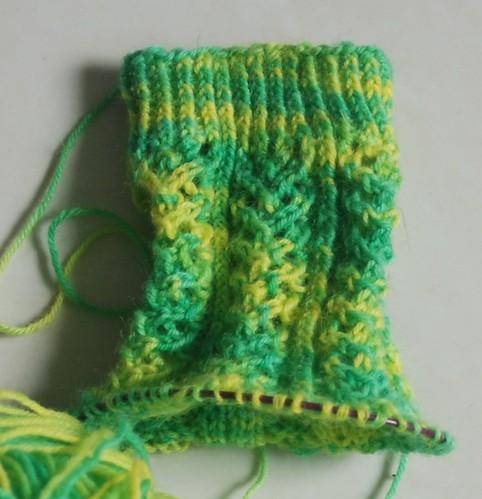
I wanted to make a pair of socks with the yarn. I didn’t want to do a scarf or hat, because putting yellow next to my face doesn’t suit me, and I already have enough pairs of gloves. I choose this sock pattern. After a few inches, it was clear that the pattern and the yarn don’t work together. The colour variation obscures, rather than shows off, the lace pattern, and I didn’t like the way the colours were pooling. I do like the pattern, and will probably knit it again in a solid colour wool.
Second attempt

For the second attempt, I found a pattern for socks using linen stitch. Linen stitch uses slipped stitches and brings the wool forward in front of some stitches, both of which mix up the colours a bit. I was hoping that this would get rid of the pooling but, as you can see, it didn’t. I rather like the part on the right, where the green and yellow are very mixed up, and if the rest of the sock had been like this I would have persevered.
Success!

In the end I bought some more wool in a harmonising colour (the dark green), and did a simple plain striped sock. This works! The dark green breaks up the large areas of yellow, and the overall effect is bright and cheery. Now to knit a second sock, so I can wear the pair...
Saturday, 7 July 2012
Japanese Rhinoceros Beetle
Japanese Rhinoceros Beetle a video by joe with a camera on Flickr.
Greetings all - if you still remember us. Sorry about the hiatus... one thing after another, and then we just got out of the habit. Anyhow, here's a good one to get back into the swing of things. If the video doesn't run automatically, click and it should take you to Flickr, where it does.
These little beauty was found on the way into work, on the pavement, upside-down. The previous day we'd found a female in the same place, and in the same rather undignified posture. Coming from a country where the bulkiest insect you can find is the stag beetle, this lumbering tank was quite a surprise.
For some reason, it didn't take long to work out it was Trypoxylus dichotomus, a relatively common species in the far east, but most typical of the northern areas. The larvae live in rotten wood for a few years before emerging (imagine the size of the hole... not great if you've got them in your furniture, I imagine), whereapon the males battle each other endlessly for the attention of the females. The ridiculous horns are perfct for flipping each other over, but can probably also inflict some serious damage on opposing appendages if twisted the right way. We found another male that was apparently unable to walk (or even stay upright - a common complaint, it seems), with one of its legs not working. It might not have been a rival... but it probably was.
These animals are apparently popular pets, and I can see why - they have so much personality. Inevitably, though, they're often made to fight each other... which is fine up to a point, of course, as that's what they do, but I imagine there's a natural limit to how often they encounter each other and choose to do battle. Less inevitably, they're apparently sold as pets in Japan... from vending machines. Yes, I'm sorry to say you read that right. Ho-hum.
A few interesting facts... I read on forum somewhere that the size of the adult depends on the quality of the food given to the larvae (reasonably enough). Those who tried feeding them an apparently nutrient-rich diet of leaves and mulch, however, ended up with smaller adults than those feeding them on wood alone. I guess their digestive system is geared towards wood, and they can get more from a twig than they could from a hefty Greek salad with added bamboo shoots.
Apparently (http://natureafield.com/?p=722) the enormous horn doesn't stop the males flying as far and as fast as the (hornless) females. To compensate for the weight, they've evolved larger muscles and so on, which presumably does require more energy... so I'm not sure exactly what the study really showed, to be honest. Interesting, though, and it must be quite fun sticking tiny radio transmitters onto them.
Finally... apparently they have quite a mainstream profile in Japanese media. If anyone has seen the classic (sort of)film "Godzilla vs. Megalon", you may notice some familiarity in Megalon's facial protuberances... yes indeedy, the god of Seatopia is apparently a giant bipedal mutated T. dichotomus... and yes, I really, really should leave it at that.
Friday, 16 March 2012
Prehistoric cucumbers
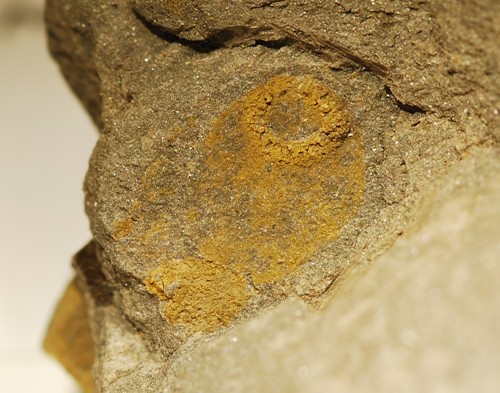
Top o’ the mornin’ to ye. Lucy's still sunning herself in the desert, finding sponges, arthropods, and who-knows-what, so you're stuck with me again. Once she's back we're hoping to have - shock, horror - a brief holiday, and go somewhere spectacular. Before then, though… time for some more fossils.
This is based one of our papers, just out in the open-access online journal Palaeontologia Electronica, published by the Palaeontological Association. At some point we'll write about the whole debate over science publishing, but suffice to say that open access is a Good Thing. Did you know that authors have to sign away their copyright to the journal, and are often asked to pay a few hundred pounds for the privilege, before the journal sells the paper at £30-40 a go, and charges ridiculous subscription charges for academic libraries, with no royalties whatsoever to the authors? Palaeo Electronica isn’t the highest-impact journal, but it’s one of the ethical ones. Anyway, that’s for another day. The point here is that you get to read the paper for yourselves, should you be that way inclined:
http://palaeo-electronica.org/content/2012-issue-1-articles/191-welsh-holothurian-bed
In outline, what we’ve got is another fauna from the Ordovician of Wales with some exceptional preservation of squidgy things in it. Unlike the Llanfawr fauna we talked about before, this isn’t in some nice useful exposure like a quarry – it’s a tiny, crumbling bank of shale with trees on top, on the side of a stream valley that’s so dim you can barely see anything on a hot summer day due to the thick canopy. The shales are deeply weathered, and although there was pyrite there once (good for X-radiography, remember) it’s not there anymore. What we’re left with are rusty shapes on crumbly grey rock, which we can’t see until we’ve got out into the open.
The reason we bother with it is that there are – you guessed it - sponges! Lots of sponges. There are probably a dozen new species. There are also palaeoscolecid worms (we’ll go into those when the paper comes out in the next couple of months), trilobites (yawn… no, they’re cute, really), and various other gubbins. The gubbin that is most exciting, though, is a small number of sea cucumbers.
Sea cucumbers do not appear as fossils very often. Unlike their cousins the sea urchins and starfish (all included in the echinoderms), they don’t have a rigid skeleton. The plates of an urchin’s test have been reduced to tiny sclerites (rather like sponge spicules) embedded in a leathery skin. The only really robust bit is a ring of plates around the pharynx, which you can see in the photo. They’re truly delightful animals – the only things I know of whose defence mechanism is to spit their intestinal tract out at anything that bothers them. It’s ok – they grow a new one afterwards. Just down the road from us is a restaurant that advertises, “Specialist in Sea Cucumber!” so obviously someone else appreciates them too.
Anyhow, although they turn up regularly on reefs, sea cucumbers really come into their own on the abyssal plain. Great herds of them march across the muddy plains, filtering yummy marine snow out of the water, or digging through the mud for delicious little morsels. They’re one of the most abundant large animals on the planet, where some authors say that they make up nearly 90% of the deep marine animal biomass. They also have many clever abilities, such as buoyancy control and burrowing ability, which is all quite impressive for something with no brain.
One of talents they don’t have, though, is being fossilised. There are very few examples of complete fossil holothurians, with the oldest until now being the Late Silurian of Australia, 50 million years later. There are some isolated, microscopic sclerites and plates from the same sort of age as ours, but until now, no whole ones. At this stage, I should explain what’s important about the Middle Ordovician, regarding echinoderms. There are numerous extinct groups of echinoderms, but the living ones all appear in the Ordovician (except the concentricycloids, but they’re just weird, and are probably merely a strange group of starfish). The crinoids appear in the earliest Ordovician, the starfish (in the form of the extinct somasteroids) around the same time, followed by the true starfish and brittle-stars, and then finally the sea urchins and holothurians. The latter two appear for the first time in the Middle Ordovician; in fact, we’ve got the oldest sea urchin too, but that’s not published yet. They are also believed to be very close relatives, so the earliest ones should show features that are somewhere between those of the two groups…
Until now, that really wasn’t true – and in a way, it still isn’t. There’s a truly bizarre extinct class of echinoderms called the ophiocystioids that might be close to ancestral holothurians, and the bothriocidaroids appear to be an early branch off the sea urchin lineage, but there’s really nothing that shows anything like a clear transition between the two groups. Ours helps a little bit, in that it’s got traces of a sea urchin-like skeleton in the form of reduced ambulacrae – the lines down the side of an urchin, where all the tube feet go. These skeletal ambulacrae are completely lost in modern holothurians, which makes the feature particularly important, and it actually ties in with some predictions made years ago by a German researcher. Isn’t it nice when science actually works?
There’s still a fundamental question remaining, though – where did they come from? Both urchins and cucumbers appear in the fossil record in the Middle Ordovician, in obviously primitive but still recognisable forms. There’s nothing obviously related before them, and there’s nothing (except ours) that’s clearly intermediate. We now have diverse Early Ordovician faunas like the Fezouata Biota, replete with abundant echinoderms, but nothing there that could be closely related to urchins – although there they do find somasteroids in abundance, along with edrioasteroids, which might be the ancestors of them all. The fossil record is pushing us towards thinking that these groups really did evolve in an extremely short space of time…
The thing to remember, though, is that the fossil record lies. It hides things. It gives you glimpses, and then pretends that the rest isn’t really there. Anything living in shallow water, for example, tends to get obliterated before it even has a chance to be fossilised. Our undescribed urchin is from Llandegley Rocks – conveniently, a shallow-water deposit preserved due to being on the side of a subsiding volcano. Coincidence? Maybe. Or maybe the urchins and cucumbers really did evolve in the Early Ordovician, but in a place where we can’t – yet – see them. Time to get the hammers out again, then.
Saturday, 3 March 2012
There's nowt as queer as Folk
Brian Boru's March a video by joe with a camera on Flickr.
Hello again all… Lucy’s on her way to Morocco at the moment, so you’re stuck with me again, in cold, murky Nanjing. It’s trying to be spring, but not quite managing it yet. We did promise all sorts of random discussions on here, so this one is going to be more random than most…
There we were the other day, sitting in Finnegan’s Wake (the local Irish pub) and listening to the Irish Rover (or something), and the discussion started meandering over what makes something folk music. We ended up getting tied up in so many knots, and having to think about so many different things, that we decided we ought to write some of it down. As you may know, we both sing a bit of traditional folk, while I do a spot of harping and Lucy flutles (flauts? flaunts?), with a bit of persuasion. We used to go to folk clubs in the UK, and were often struck by what many people were performing. To us, Bob Dylan isn’t folk. Neither is Simon and Garfunkel’s stuff. They may be very nice, and perhaps one day we will class some of it as folk music, but not yet, surely? But then, why not? And what about Enya? Was everything that Clannad did folk, or Runrig? It started to get quite complicated…
When we personally talk about folk music, we mean the really traditional stuff – you know, at least a century or so old, and (if it’s a song) preferably in a long-lost Celtic language. Or Elvish. But obviously, there’s more to it than just the age – a lot of classical and religious music goes back just as far. Of course, one doesn’t dress up in black tie to go to a folk concert, and a typical folkie in the ballet theatre would stand out a mile, so there must be a deep division somewhere. So what other differences are there, besides calling a violin a fiddle?
You could argue it was partly down to the instruments, but there’s a lot of similarity. Some of Rodrigo’s solo guitar stuff could almost *be* a folk rendition, and a lot of the folk instruments have near-exact (although admittedly grander) counterparts in classical circles. Except perhaps bagpipes… can you imagine a ‘Great Highland Pipe sonata in E minor’? No, don’t even try. [Edit: just checked, and Bartok, believe it or not, did indeed write a bagpipe sonata. And he’s not the only one.] You could find differences in the style of the music, perhaps, but how much of the classical repertoire is based on folk melodies? Mazurkas, anyone? The point is that there are a lot of points of overlap, and occasionally it’s very hard to tell the difference.
Eventually we decided it was all about the purpose and meaning of the music, and what you’re allowed to do with it, rather than anything about the music itself. Modern pop music is mostly about the performer – the good old celebrity. They can cover someone else’s song, but people talk about the singer rather than the song. Classical seems to us to be about the performer some of the time (but only really when you’re dealing with the best), but more often it is the composer – it’s the perfect arrangement of notes written down a century ago, and the arrangement of notes must remain. Of course, there are ‘fantasias on a theme of…’ – but these also are fixed. They are like paintings: to be admired in the form in which they were created. Leeway is allowed in the interpretation and intonation of the notes, but the notes themselves must remain. I remember once when Pavarotti hit the news for making three mistakes in a concert. The crowd were screeching for their money back. When Loreena McKennitt started singing the wrong song, everyone laughed along with her, and the poor confused musicians thought it was hilarious.
Folk tunes, in contrast, are about as loosely defined as it gets. Usually only the melody is written down – you’re meant to make up the harmony as you go along. Better than that, though, is that the tunes themselves are flexible. They’re often organised simply, with several repetitions of a primary section, and the musician is actively encouraged to make twiddles and add squiggles here and there, as they see fit. And what about the lyrics? They’re even more subject to change: for old songs, there are often numerous versions in circulation, and you can pick up different verses of old favourites from buying a new recording. Of course, being out of copyright helps a lot…
Perhaps the best example of this is “Two Sisters” (or numerous other titles, including “The Bonny Swans”, and “Dreadful Wind and Rain”). The basic story is that two sisters walk along a riverbank (or the sea), and the older pushes the younger in. She refuses to help her out unless the poor girl gives her ‘her own true love’ (or some variation on that). The girl drowns and gets swept away, eventually being found by a miller, his daughter, or a passing minstrel. Usually, she gets made a harp (yes, yes, I know… just accept it, right?), and eventually gets taken back to her old home, where she spontaneously sings a song (yes, you can do things like that in faerie tales) denouncing her sister. There are hundreds of versions across Europe, in many languages, and no-one even knows where the original came from.
It works backwards too – popular lines can be transplanted into entirely different songs, and turn up anywhere. An example of a ‘floating line’ is “I leaned my back against an oak, thinking it was a trusty tree; but first it bent, and then it broke, and so has my love done to me” – a popular sort of theme for folk songs in general.
So what’s it all about, then? It’s partly about the performer, but it’s noticeable that the most successful Celtic folk musicians tend to diverge more and more from the traditional tunes and move towards creating their own. Enya, for example, started out with Clannad, but wanted to perform her own, more commercial material. Interestingly, Clannad also headed in the commercial direction, but their early recordings are almost entirely traditional tunes. Many of the best folk musicians today (e.g. Julie Fowlis) are almost unknown outside followers of the genre. I have some beautiful cds for which I can’t even remember the singer’s name. Somehow, though, that doesn’t really matter.
So folk does not centre on the performer, and obviously not the composer. The lyrics and the notes are flexible, and the instruments and style, although they tend to conform to certain stereotypes, also overlap with classical. We decided the answer was that folk music is about the meaning of the music rather than the outward appearance. The songs reflect moral lessons or helpful ways to think about things in order to overcome one’s own difficulties, or they are ways of remembering old stories. In many ways, folk songs are like faerie tales, or the stories told around campfires. The tunes themselves, like all music, carry with them emotions and atmospheres, but most of the folk tunes I know of that have no songs attached are for dancing to. There are slow tunes – airs – as well, but these inevitably seem to have lyrics added, if they’re weren’t around originally. The musicality of folk is really just for the sake of being musical; it’s not the main purpose of it. There’s a joyousness in folk performers that you rarely see in other types of music (except jazz, maybe).
So there you have it; I’d like to think that folk really is primeval. It’s maintaining what music was first made to do: as a way of remembering things, of passing on stories and ideas about what really matters. But perhaps the true folk tradition is an anachronism in the music world today, because the situations it refers to don’t really happen nowadays? I think I’d disagree – the situations are the ones most fundamental to the human world, even if the specific examples are long gone. These songs are mostly about life, love, and loss. Perhaps they can’t solve all your worries, but at least you can share them with long-lost minstrels, and know that someone understood.
As a final word, I’m also glad to say that Wikipedia seems to be having as much trouble defining folk music as we are. There’s much more to the discussion over there: http://en.wikipedia.org/wiki/Folk_music
Subscribe to:
Posts (Atom)