
In case you think we're really behind the times, it is of course Chinese New Year. the buses are empty, there are charred scraps of red paper blowing in the gutters, and Lucy's currently working on the laptop while snuggled up in bed - Ah, the good old Nanjing winter!
This year falls under the Dragon's influence in the Chinese Zodiac, which is strangely appropriate, as we both do as well. Lucy's close to being a rabbit, it must be said, but you only see that side if you offer her a carrot. Apparently dragons are very independent, and work best on their own (oh dear); they prefer to live on their own terms and not be ruled by others, while they go about their creative things, eccentric experiments, or whatever. While this might sound strangely familiar, I've always had some problems with the concept that everyone born in that year operates the same way. Every twelve years it would be total anarchy... but then, perhaps that's why the school year doesn't coincide with the Chinese year, but is almost six months out - a schoolyard filled with an even mix of rabbits and dragons does more-or-less fit my memories...
Anyway, what I hadn't realised was that the Chinese Zodiac also goes through a cycle of the five elements. This is the year of the Water Dragon, who is by all accounts a very reasonable sort of beast. Apparently they counteract the blazing emotions and recklessness of fire dragons (guess what we are... reckless? really? Well, I guess we did decide to come out here in the first place). You've got to say, though that the prospect of schoolrooms filled with a year's worth of fire dragons is rather a terrifying prospect.
Anyway, enough of this silliness. the festivities went off in true Chinese style (as always, click on the photo to get to Flickr, where in this case there's a little video of the fireworks from our window). We were hoping to find lots of photogenic, noble-looking dragon statuary and ornaments, but there are almost none to be seen. The official dragon is a strange deer-like thing that's always depicted as a cartoon or a fluffy toy. Someone hasn't read the stereotype... either that, or everything is aimed at children, which is quite likely. After all, go to the UK at Christmas, and how often do you see a non-stereotypical, jolly Santa? I guess these celebrations are not really about the meaning any more, here or back home. It's the occasion that matters nowadays, the giving of huge boxes of oranges (very nice ones, but we'll be eating them for weeks), and the chance to go join the crowds at the fair and win a stuffed Garfield.
Having said all that, guess where the biggest crowds we saw were? Not at the parks, but at the entrance to the local Jiming buddhist temple. Yes, there were loads of balloons with Winnie-the-Pooh and similar local characters, but in an officially non-religious country, this mass attendance suggests that at least some of the traditions are deeper-seated than just enjoying the festivities...

Wednesday, 25 January 2012
Happy New Year!

Thursday, 19 January 2012
News from the canine fashion world

We've now been here a year (wow... I can't decide whether it feels much shorter or much longer...), and the time seems right for a few balanced impressions about this strange, confusing and strangely endearing country we've ended up in. Perhaps slightly oddly, I can't help thinking that this poodle sums a lot of it up rather nicely.
Never before, anywhere, ever, have I seen a dog wearing trainers. Eating them, yes, but not wearing them. Add to this the rather natty coat and headwear, and you have one very smart-looking pooch. It's surreal. It's utterly daft, and in the UK hardly anyone, I dare say, would have the nerve to be seen out with such a sophisticated companion. Aside from the jeers and laughter, such an owner would doubtless be worried about being upstaged - and we couldn't have that, now, could we?
In China, the bizarre (by our standards) is commonplace. No-one bats an eyelid at young women wearing what can only be described as wedding dresses (or the ultimate in ball gowns) while out shopping. Nor do people seem to notice someone pausing in their walk through the woods in order to let out an immense, ear-splitting yell. Well, of course you wouldn't notice, would you? It's just someone out doing some exercises.
I get the impression that people here generally do not care about irrelevant appearances all that much (how else to explain the spectacularly noisome dustbins just outside the front door of a swish restaurant?). What matters is whether something works, and whether it happens to be what you have.
There is a huge gap between rich and poor here, but the great majority are in the poor end. I'm sure there's envy, but on the other hand, the rich are clearly distinct and not really relevant to most people. Among the normal townsfolk, everyone seems remarkably equal. Whether dressed in ragged robes or a natty coat and four matching trainers, you're just as worthy of a seat on a bus, or being served in a restaurant. Perhaps someone has very little money; that's just the way it is. Perhaps someone wants to dress up to be completely over the top; that's fine too - it's their choice entirely, and they're not going to get laughed at because of it.
On the other hand, there are the apparent paradoxes. This acceptance of other people's behaviour (within reason, if not *reason*) is not a lack of interest; the Chinese people in general are intensely sociable, and very interested in what other people are doing. They seem to manage this without being judgemental, though, which for westerners like us is a beautiful novelty. Although we get a lot of attention [It's the beard - Lucy], it's always amicable or simply curious. We get people staring at us, wanting to have their photos taken with us, and so on, but it seems to be a genuine interest. Never once have we felt the hostility that many overseas pioneers have met with in the UK. It's just not part of the culture.
I think perhaps that this openness to new ideas or surprising discoveries is what explains that self-satisfied poodle. It's like the cake shops, you see. They've taken the idea of a cake (completely alien a few decades back, I'm guessing) and taken it to extremes. There are dozens of little patisseries around now that have an extraordinary selection of startling creations, smothered in icing and little creamy parapets. Bored with plain cake? Then go for one of the ones with a layer of ice-cream instead. Why not? Like everything else that goes on in China, it works.
And so, back to the poodle. It looks ridiculous? Fair enough, but it's warm, and its feet aren't cold and wet. And nobody they walk past seems to care... but I bet they do, really. I bet half of them are thinking about doing the same, if they've got a dog. If they can't afford it, they're probably thinking about sewing up little booties themselves. Because, you see... it works.
And that's why they can complete the biggest engineering project in the world ahead of schedule and under budget - and why they're rapidly taking over the world's economy. They take whatever works and improve on it, without worrying too much about whether it sounds silly or might be embarassing. And that is one of many reasons why the country is so beguiling for those who get to spend some time here. Let's hope we can unravel some more facets over the coming year. After all, we're probably completely wrong, and anyone Chinese reading this will probably be laughing uproariously. But we'd like to think they won't mind our misconceptions, and will take them in the spirit in which they're meant. If you're reading this: perhaps we'll never understand this extraordinary country, but we're going to have fun trying. :)
Wednesday, 4 January 2012
Happy New Year!

Happy New Year (the first New Year of the year) to all our readers!
We’ve been in the UK for a few weeks, visiting two museums, two universities, one library, one dentist and eleven relatives, as well as doing conference presentations. Internet access has been extremely limited lately, hence the lack of blog posts. We’re now about to fly back to China, and hope to be updating the blog more regularly this year.
In the meantime, here’s a nice picture of the penguin I made with the turmeric-dyed yarn I blogged about a few months ago. As you can see, the dye worked very well. The penguin complained of being cold (I thought they were supposed to like that, but apparently not) so I had to make a little hat and scarf too.
Sunday, 11 December 2011
And now for something completely different...
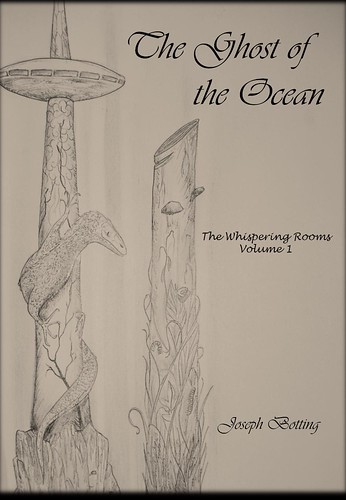
From the sublime to... well, you get the idea. Some of you know I've been trying (and often failing) to write a series of fantasy books over the past few (well, fifteen) years. Thanks to the wonders of Kindle, I've finally gone and published the thing. You know how people always say how hard it is to get something into print? Well, it's true - unless that's just because mine's awful, of course...
Anyway, it's with a strange sense of trepidation that I can say that 'The Ghost of the Ocean', being the first part of 'The Whispering Rooms', is now available for the purpose of immediate boredom-relief* to anyone with a kindle (or kindle app on their computer, of course). It's only available through Amazon at the moment:
http://www.amazon.co.uk/Ghost-Ocean-Whispering-Rooms-ebook/dp/B006KRI97I/ref=sr_1_3?ie=UTF8&qid=1323668895&sr=8-3
Apologies for the interruption to your scheduled fossils, knitting and random burblings about China. Normal service will be resumed shortly.
*No guarantees, mind. For those unaffected by the alleged boredom-relieving properties, I propose to advertise it as an over-the-counter soporific instead.
Saturday, 10 December 2011
Burgess Shale sponges
Dear all,
Apologies for the recent silence… we’ve been trying to finish off all sorts of things before the end of the year, and are flying back to the UK tomorrow for a “holiday”. This actually means going to a conference and a couple of museum visits as well, plus I’ve just been told I’ve got a couple of reports to write up and an hour-long presentation to do as soon as I get back, but we’re still looking forward to a decent break. You never know, we might even manage a blog post or two…
This one I wanted to write as a belated little something about the Burgess Shale. I spent three weeks working in Toronto, so perhaps you’re curious why..? Or perhaps not – but I’m telling you anyway. The reason is, the Burgess Shale contains some of the most astounding fossils to be found anywhere in the world. From the point of view of sponges, they probably are the best anywhere. The fossils come from a series of spectacular locations high in the Rockies in British Columbia. I’ve not been there yet, but I’ve now been invited to join in their fieldwork when I get a chance, which is a deeply exciting prospect.
These rocks are famous because they preserve soft-bodied animals and plants as well as the ones with skeletons – an entire menagerie of weird and wonderful creatures, from very early in the history of animals. They’re middle Cambrian in age (about 505 million years ago), and when discovered over a century ago, they gave us a first glimpse of what the squidgy things were doing at this point in history. The site was made famous by Stephen J. Gould’s book ‘Wonderful Life’, and has now entered mainstream culture through more books, magazines and television. For some reason, metre-long predators with pineapple-ring mouths and huge grasping appendages (Anomalocaris) and strange walking worms with enormous spines on their back (Hallucigenia) have managed to grab hold of popular attention. Strangely, though, the sponges are normally used as a background – literally. In reconstructions, all the interesting creatures are invariably seen scuttling in, on or around the sponges. It’s just not fair, and this is a little attempt to set things straight.
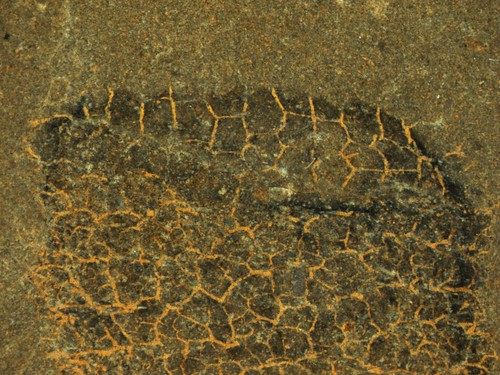
The sponges of the Burgess Shale have been studied in exhaustive detail three times – by Charles Doolittle Walcott (the site’s discoverer) in 1920, by J. Keith Rigby in 1986, and by Rigby and Des Collins in 2004. At each stage the diversity has increased, and it now stands at something near 50 species. Some of these are known from other sites around the world, in Utah or China, but many are endemic and have never been seen elsewhere. Several represent the only example of entire families of sponges in the fossil record, and most of the rest are the best examples. Take this picture here. It’s a sponge called Vauxia bellula, described originally by Walcott, so it’s very well known. This fossil is just astonishing. There are actually three levels of preservation here, and normally you don’t get any of them. The easiest to preserve is probably the organic meshwork that forms the orange lines; I’ve seen this type of preservation once from Scotland, and once from Herefordshire, and it’s also found in the Cambrian faunas of China and a few other famous fossil faunas. This is the type of material that your bath sponge is made of – in fact, it’s probably close to being a direct ancestor of that group. Bath sponges do not generally fossilise at all – they rot away and vanish before they can be preserved. In this case, it seems to have been preserved through being replaced by iron pyrite – fools’ gold – and then weathered to rust. And that’s the easiest bit, remember.
Under a microscope, the fibres are cored by truly tiny spicules. These were originally silica (opal-A), which dissolves very easily in warm water, but is more stable in the deep oceans. Despite the fact that they don’t rot away, these spicules are so tiny that they rapidly dissolve – you hardly ever see sponges with type of skeleton in the fossil record. Even in the famous fossil deposits of China you don’t see them, although I have reason to believe they were probably there. It also takes a different type of preservation to keep the spicules than it does to preserve the fibres they’re embedded in. So, to preserve the spicules as well as the fibres is really astounding.
But what about the third part? Well, you see that black stain covering the entire sponge? That, it appears, is the soft tissue of the sponge, the gooey jelly that has no chance of being fossilised at all. And best of all, that really does appear to be carbon – it’s a remnant of the original organic tissues, preserved without being turned into a mineral. This is the truly staggering bit about the Burgess Shale, and the real mystery behind the preservation of its fossils. To preserve really soft organic materials like this, you need to stop bacteria eating it – and there’s your problem. Take away all oxygen? No problem – the methanogens and sulphate reducers get to work instead. Highly acidic conditions? Not an issue for some of them. Boiling water and toxic metals? Sounds like a holiday for some groups of Archaea. For whatever conditions you can imagine in the sea where the Burgess Shale formed, there should have been absolutely no problem at all with bacteria living in the sediment. So how on earth did these fossils survive?
There are a long list of papers that have tried to address this, some with considerable success. Most of them, however, have focussed on other aspects of the preservation – the clay mineral films that coated the fossils, the calcium phosphate that formed in their digestive tracts, or the bits of pyrite that replaced certain structures. As far as I know, and despite some very intriguing suggestions, the organic carbon is still a mystery…
But what do I care? From my point of view, the result is that I get access to the most exquisite fossil sponges anywhere in the world, and can see both the skeletons and the soft tissues. And when you can all this, there are surprises – things that have been overlooked, despite those three monographic papers. There are vauxiids – sponges related to this one here – with a long, soft peduncle, and the soft tissue separated from the cage of the skeleton. There are others with utterly bizarre, unique spicules making up their skeleton, but with the strange bits composed of organic matter rather than opal. There are some… but no, I can’t tell you about that yet. That’s just too weird, and I don’t even know how to describe it. Let’s just say, for now, that there is more to these sponges than meets the eye. If we didn’t know better, we might think that they were much more complicated organisms way back in the Cambrian than they are now. Of course, we do know better… right?
For more information on this wonderful fauna and a whole stack of fabulous photos, please visit the recently launched website at: www.burgess-shale.rom.on.ca
Tuesday, 29 November 2011
Guanling Lagerstätte
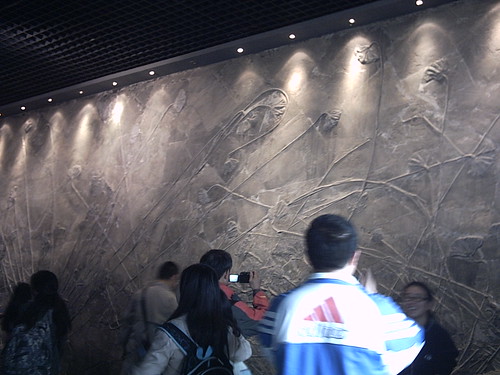
One of the places I went to on my recent South China trip was the Guanling Lagerstätte. This is Late Triassic in age, about 220 million years old or so – so considerably younger than the rocks we normally look at. As is often the case in China, the fossil site has been made into a museum. There is a purpose-built building housing a lot of fossil material and a short walking trail around some of the outcrops. Some of the larger fossils (mostly ichthyosaurs) have been left in situ and had protective shelters built around them.
The photo shows slabs with lots of crinoids (sea lilies) on display in the museum. The crinoids are thought to have been attached to floating logs (although it’s only fair to say that this isn’t universally accepted, and the crinoids may have grown on sunken logs on the sea floor instead).
More photographs on flickr, showing marine reptiles, crinoids and their logs, and more of the museum displays.
Lucy
Saturday, 5 November 2011
Garden at Huanguoshu waterfall
It’s been a busy few weeks. After I came back from the conference in the US, I went off to Guizhou Province, South China for two weeks of fieldwork. The first week was with an Argentinian graptolite worker who was visiting Nanjing, so we went around already known sites. Some of them I had seen before, but it’s always good to go back to places, especially as I found a couple of sponges! For part of the week I “attended” the conference of the Palaeontological Society of China. “Attended” because I only went to the opening ceremony, and the rest of the time either worked in my hotel room or went to various interesting tourist sites with the Argentinian. There was little point in attending the talks, as they were entirely in Chinese and my language skills are not yet good enough to understand much.
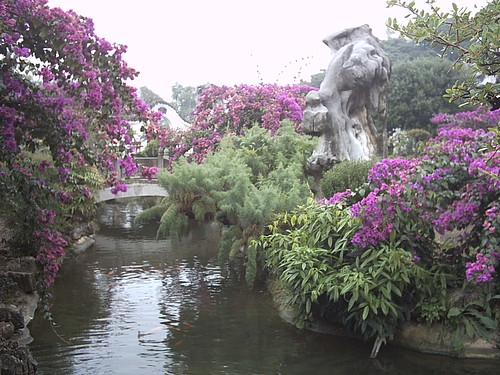
The photo was taken in a garden at one of the sites we visited, called Huangguoshu Waterfall. I thought it looked like a stereotypically Chinese scene. The waterfall itself was about a hundred metres long, and there was a cave behind it, so it was possible to walk all the way round. Pictures of the waterfall are on my flickr photostream (click on the photo to follow the link).
The second week of fieldwork I went back to a site I had collected from earlier this year. I went to the site looking for graptolites, but also found various interesting things including worms. This time the worms were a bit lax in coming forward – none were found until the last hour of fieldwork, and then three came along in quick succession! I’m currently writing up a paper for publication, so more details will be forthcoming once that comes out.
Joe is currently in Canada looking at Burgess Shale sponges. I expect he will do a blog post about his adventures sometime.
Lucy