Via Flickr:
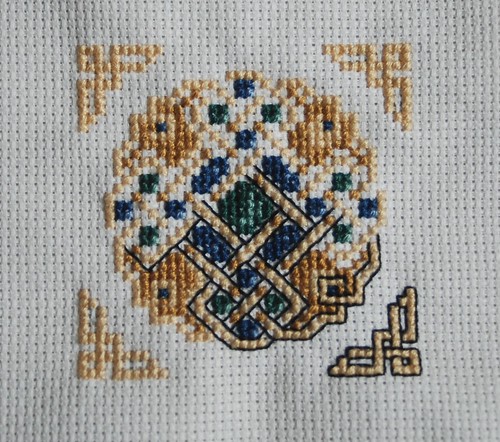
My favourite part of any cross stitch project is the outlining. After all the long work of doing the cross stitches, the back stitch goes quickly, and really makes the piece look finished. Here, the black lines turn random bits of yellow into a Celtic design, and the separation of colours into blocks makes the blue and green show up more clearly.
This is a small kit for a coaster that my mother gave me. I had to modify it slightly from the design given. Firstly, the design was yellow, green and red, not yellow, green and blue as I have done it. This is because, instead of having two lots of red thread, the kit contained one lot of red and one of blue. I decided I liked the blue better, so used that, and was very frugal with the amounts given. There would have been enough thread, except that I managed to lose the last of the blue. The original design had the little twirly bits around the edge filled in, so I unpicked those and thereby gained enough thread to finish off the centre.
Now all I have to do is finish the outlining, carefully wash the embroidery, trim it to size and put it in the coaster.
In other news, we've had three papers published this week. Joe has already blogged about one of them. It's gratifying to report that quite a number of people seem to find it interesting.
Lucy

Sunday, 28 August 2011
Celtic cross stitch

Sunday, 21 August 2011
hidden fossils...
Finally! It’s taken us long enough, but at last we’ve got one of our major new sites in Wales in print. It’s coming out in the journal Geology (quite a major one, so fairly exciting) next month, and is now available online:
http://geology.gsapubs.org/content/early/2011/08/05/G32143.1.abstract (if you don’t want to pay for it – and who would? - just send us a message and we’ll email you a copy).
The story behind this discovery is quite interesting. It’s been known as a major collecting site for decades, but in these beds the only things to be found are graptolites. So we thought as well, and we’d been going there for years, on and off. We then went along one day in 2004 with Talfan Barnie, at that time an undergrad volunteering with us for experience. Strangely, someone had dug a bit of a hole in the outcrop and left a pile of scree. We assumed it was because they were looking for trilobites (they wanted the quarry around the corner, in that case) and thought little of it. Talfan sat down by the hole and started pulling loose bits out of scree. After a few moments he handed us a big slab with a quizzical expression and said, “What’s this?”
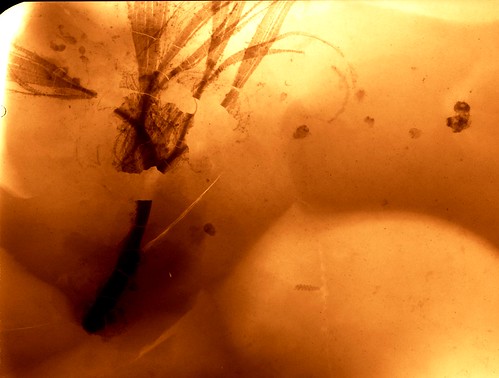
It was, needless to say, something amazing. It had a fibrous stalk, and a huge mass of filaments (tentacles, it turns out) coming out of one end. Scattered over the rest of the surface were bits of sponges, and strange pieces of things we can’t quite identify. The main fossil was similar to the one you see here (although this one doesn’t show the tentacles, and the stalk is wrapped back over itself). It’s a solitary hydrozoans – an extremely delicate creature rather like a very tall, slender sea anemone – and the chances of these being fossilised are extremely slim. The sponges you can see (little vase-shaped things) are also preserved as soft tissue – the spicules are there, but limited to the thick rim around the opening.
The fossils are preserved as iron pyrite (fools’ gold) in a soft black mudstone, which is pretty but difficult to work with. Luckily, though, it’s perfect for studying with X-rays, and that’s what you can see here. The pyrite blocks X-rays, similar to bone in a medical version, and we’ve inverted the image here to make it easier to see. Pyrite has some other problems, though – it’s very unstable. In the presence of water and oxygen, it rusts and turns into a horrible gunk with sulphuric acid and gypsum. The mudstone itself is also unworkable in the rain – it just turns to mud. In other words, in the traditional Welsh climate, the fossils don’t last long once they get close to the surface. It’s only by looking for really fresh material that you can find them at all, and it’s only by X-radiography that you can see and appreciate them. But boy, is it worth it.
We think there is a lot more to come from this fauna, although it will take time. The dominant fossils are the sponges and hydroids, but there are also worms, nautiloids with encrusters living on the shells, pieces of probable algae and as yet unidentified fragments, and exceedingly rare arthropods. The next job is to describe some of the more common species, but the best bits are surely still to come.
And no, we still have no idea who made that original hole – or whether they found anything.
Thursday, 18 August 2011
Nanjing in summer
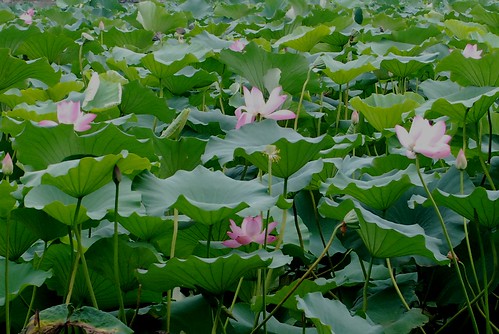
The picture shows lotus flowers and leaves growing in Xuanwu Lake, near where we work. The lake is one of the nicer places to be outside at this time of year, as there is plenty of shade and often a cool breeze off the water.
Nanjing is known as one of the “Four Furnaces” of China, and we are appreciating why. Since we got back two weeks ago, the temperature has been consistently above 30 degrees centigrade, and usually near 35, every day. It doesn’t get much cooler at night. As well as the heat, the humidity is high, and it’s that which makes the city really uncomfortable. We’re told that it should start to get cooler in a few weeks, and that autumn is quite pleasant.
At the moment the weather is mostly dry, except for the daily thunderstorms. These and the humidity mean that we’re spending most of our time in the office or at home, and not going out very much. For exercise, we’re playing badminton or table tennis a few nights a week. Both are extremely popular in China (something to do with having world champions). We also see people playing badminton in the street, often without a net. The institute has three table tennis tables and a badminton court open at lunchtimes and in the evenings.
Our office is now fully furnished; we picked up (literally) two bookcases and a desk from the library, which is going to be refurbished. Our specimens are stored in trays on the bookshelves and the nice shiny new microscope now has its own desk, rather than sharing with a laptop. There’s even a stool to sit on that’s high enough to see down the microscope. The only thing we are lacking now is the library; the aforementioned refurbishment means that it will be closed until April. Fortunately a lot of the literature is now available over the internet, which means we don’t even have to leave the office to consult it.
Saturday, 6 August 2011
Summer in Nanjing
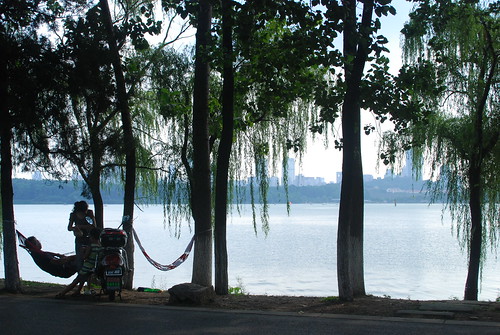
Nanjing is too hot at the moment (over 30 degrees centigrade every day), but fortunately our air conditioning is extremely efficient. Lots of watermelon and cold drinks help too!
We walked from the institute to our apartment along the lake today, and saw lots of people relaxing in hammocks in the shade of the trees beside the lake, and also lots of strolling hammock-sellers. The lake is a good place to keep cool. People tend not to go swimming, but the breeze from the water is very cooling, and there are many trees to give shade.
The lotus blossoms are out, and great stands of them grow all along the edge of the lake. The seeds are eaten, and we see people selling the seed-heads on the street. We haven't tried them yet - will report back when we do!
Friday, 5 August 2011
Giant's Head
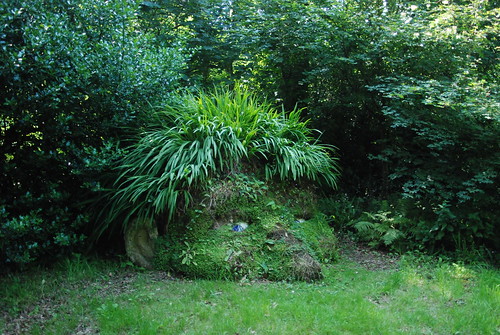
This is the Giant's Head at the Lost Gardens of Heligan (which have now been found for some time). It's a sculpture formed round a tree trunk that was too large to be moved otherwise. We went to Cornwall for a few days of holiday after we finished fieldwork. A few days of sitting on the beach, finding interesting marine life, looking round Heligan and relaxing did us a great deal of good.
We're now back in China, and hope to be able to post more regularly now.
Thursday, 7 July 2011
Fieldwork update
I can tell you that I injured my thumb on a sharp rock while hammering (nothing bad, but it did bleed alarmingly). Everyone else, while being sympathetic, then kept referring to fossils sticking out like a sore thumb, asking about rules of thumb for distinguishing sponges from random blobs, and whistling the Thumbelina song.
Tomorrow is for sorting the rocks out, putting some of them in the post to China, and sending the rest to various collaborators. After that one more day of fieldwork, and then a short holiday. We're going to Cornwall, which is mostly granite, so we won't get distracted by finding more fossils. After that, we're visiting the NHM to look at various fossils, and possibly visit some other museums/libraries as well if time allows.
In case anyone has been trying to email me: I haven't been able to access my email for a month, and I'm hoping it's just a peculiarity of the internet in this hotel, and my account isn't permanently broken. Anyway, if you've been trying to contact me, I'm not ignoring you.
Lucy
Sunday, 3 July 2011
